Can You Build Muscle With Just Dumbbells?
Published October 13, 2026
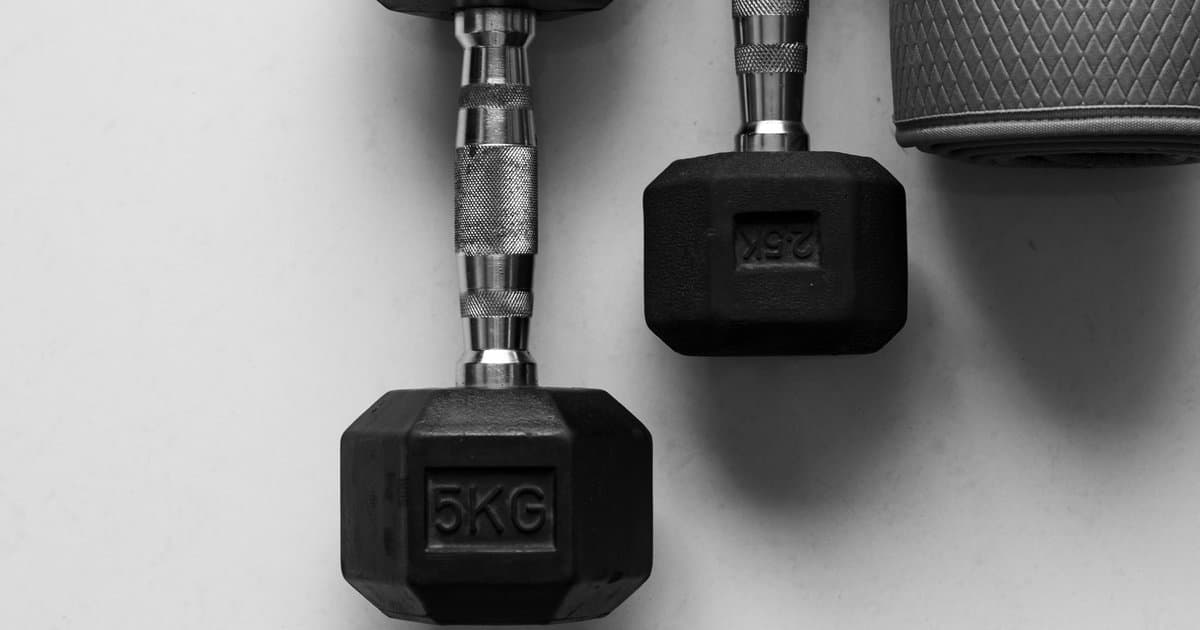
Yes. A pair of dumbbells can train every major muscle group, and for most people they can keep building muscle for a long time before anything else becomes necessary. Muscle responds to sets that are genuinely challenging, not to the kind of equipment providing the challenge. Dumbbells do have two real limits, heavy leg loading and vertical pulling, but neither one stops you from making real progress in the meantime, and knowing where they are makes it easier to plan around them.
What dumbbells cover well
A complete program needs a few basic movement patterns, and dumbbells handle almost all of them. For pressing, a dumbbell floor press or, with a bench, a dumbbell bench press trains the chest, and a dumbbell shoulder press covers overhead work. For the back, a bent-over row needs nothing but the dumbbells themselves. For the legs, a goblet squat handles the squat pattern and a dumbbell Romanian deadlift handles the hip hinge for your hamstrings and glutes. Curls, lateral raises, and triceps extensions round out the smaller muscles. Each side of the body also has to work independently, which keeps a stronger side from quietly doing more of the work.
The two places dumbbells fall short
The first is heavy leg training. Your legs can eventually handle more weight than you can comfortably hold in your hands or at your chest, so the limit becomes your grip and setup rather than your legs. Single-leg exercises like the Bulgarian split squat push that point back a long way, since each leg works against the full load on its own. Past that, a barbell and rack become the next step, which the post on whether you need a squat rack covers in more detail.
The second is vertical pulling. Dumbbells can row, but they can't replicate a pull-up or a lat pulldown, so all of your back work comes from rowing. Rows still train the lats and upper back well, but if you want pull-ups in your routine, a pull-up bar is an inexpensive addition that fills the gap.
How to keep progressing with a limited set
Progress comes from gradually asking more of the muscle over time. The simplest way to do that with dumbbells is to work through a rep range, then move up to the next weight once you can hit the top of the range on every set. When you've reached your heaviest dumbbell, there are still useful options: add reps toward a higher but still challenging range, slow down the lowering part of each rep, or switch to a single-limb version of the exercise so the same weight becomes harder. An adjustable dumbbell set with small jumps between weights makes this much smoother than a few fixed pairs with big gaps between them.
Want a dumbbell plan that's ready to go?
The 3-day full body dumbbell program is built for beginners, and the adjustable dumbbell program is a 4-day plan for intermediate lifters. Or build your own around exactly the equipment you have.
Frequently asked questions
Do light dumbbells and high reps still build muscle?
They can. A 2017 meta-analysis comparing lighter and heavier loads found similar muscle growth when sets were taken close to failure, while heavier loads still built more maximal strength. The catch is effort: a set of 25 with a light dumbbell only counts if those last few reps are genuinely hard, which is more uncomfortable than a heavier set of 10.
How heavy do my dumbbells need to go?
It depends on the exercise and on how strong you are, but upper-body isolation work like curls and lateral raises needs far less weight than leg exercises do. That's why an adjustable set with a wide range tends to last much longer than a few fixed pairs. Your legs are usually the first place you'll feel the top of your range.
Do I need a bench to go with my dumbbells?
Not to start, but it's the most useful addition. Without one, the floor press stands in for the bench press and rows are done bent over. A bench adds full-range and incline pressing, chest-supported rows, and split squats with the back foot elevated, which together cover a lot more of the body comfortably.
Can dumbbells build bigger legs?
Yes, especially early on. Goblet squats, lunges, split squats, and Romanian deadlifts train the whole lower body. The limit is how much weight you can hold, not the exercises themselves, so single-leg movements become more important as you get stronger, since they challenge each leg with less total weight.
Source: Schoenfeld BJ, Grgic J, Ogborn D, Krieger JW. "Strength and hypertrophy adaptations between low- vs. high-load resistance training: A systematic review and meta-analysis." Journal of Strength and Conditioning Research, 2017. Read the study on PubMed ↗